
Source: ConservativeNewsandViews.com
During his campaign, de facto President Barack Obama promised to build a civilian security force at least as well armed as the military. Lovers of liberty have feared his intent to declare martial law ever since. Yesterday a report appeared in a major newspaper, giving the American people fresh reason to fear such martial law. The martial law directive Deputy Secretary of Defense William J. Lynn issued the final martial law directive on December 29th, 2010. He did this during the winter holiday season. No one would be likely to pay attention. Considering what that directive says, he acted shrewdly indeed. Directive 3025.18 provides for Defense Support for Civil Authorities, or DS CA. Most of that support would be of the kind anyone would normally expect. Say a major fire broke out in a city, and the local fire department could not cope with it. To have the military help put out this fire would make sense.
But Directive 3025.18 goes further. It says the President may send troops to quell uprisings. One of two things would have to happen before the President could do this:
- Roving gangs might start shooting, stabbing, or otherwise killing people at random and smashing public or private buildings or other property.
- Local authorities might decide they cannot or will not protect federal installations or federal functions. The directive does not say what those functions might be.
The Posse Comitatus Act
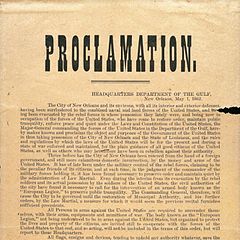
Proclamation of occupation and martial law in New Orleans after the city’s capture by US forces from rebels during the War Between the States
This comes close to violating the Posse Comitatus Act of 1878. President Rutherford B Hayes signed this into law. It was a direct response to the spectacle of federal troops supervising elections in the South after the War Between the States. Under that law, military forces do not engage in civilian law enforcement. (They may not, literally, serve as posse comitatus, or “the power of the county.”) The law allows rare exceptions, like extreme weather or rebellion. This directive goes further than that and allows martial law in a circumstance falling well short of active rebellion. Or perhaps these are pretty secretary issue this directive in anticipation of rebellion.
Why might the presidents have to declare martial law? What kind of circumstances did the deputy secretary think of when he wrote it? Look again.

 Serve Him in the Waiting