
It’s been said that an ounce of gold could buy 350 loaves of bread in Biblical times. Today, an ounce of gold still buys about 350 loaves of bread. However you slice it, whether the system falls into a deflationary depression like the 1930’s or an inflationary recession like the 1970’s, gold will maintain its purchasing power—Tyler Durden | Zero Hedge
Actually what the Bible says (In Revelation 6:6) is that it will be a measure of wheat for a penny, and 3 measures of barley for a penny. A penny was essentially the value of a full day’s work or a days wages (see Matthew 20:2, and 9), and equal to about 14¢. A “measure” was the standard daily amount needed to feed one man, and equal to about a quart or in dry measure,1/4 lb. Barley was the food of the poor, being cheaper. A Bushel is about 9 and 1/3 gallon. I have highlighted in red, the statement about the price of a bushel of wheat so that you can note the modern comparison from a screenshot of today’s real-time wheat price from quote.com which provides the daily stock prices on farm commodities. (Screenshot below).
Barnes Commentary on this passage in Revelation:
A measure of wheat for a penny – The word rendered “measure” – χοῖνιξ choinix – denotes an Attic measure for grain and things dry, equal to the 48th part of the Attic medimnus, or the 8th part of the Roman modius, and consequently was nearly equivalent to one quart English (Robinson’s Lexicon). The word rendered “penny,” δηναρίον dēnarion – Latin, denarius – was of the same value as the Greek δραχμή drachmē, and was equivalent to about fourteen cents or seven-pence (circa mid-19th century). This was the usual price of a day’s labor, Mat_20:2, Mat_20:9. The choenix, or measure of grain here referred to, was the ordinary daily allowance for one man (Odyssey xix. 27, 28). See Stuart, in loco. The common price of the Attic medimnus of wheat was five or six denarii; but here, as that contained 48 choenixes or quarts, the price would be augmented to 48 denarii – or it would be about eight times as dear as ordinary; that is, there would be a scarcity or famine. The price of a bushel of wheat at this rate would be about four dollars and a half * or 18 shillings – a price which would indicate great scarcity, and which would give rise to much distress.
And three measures of barley for a penny – It would seem from this that barley usually bore about one-third the price of wheat. It was a less valuable grain, and perhaps was produced in greater abundance. This is not far from the proportion which the price of this grain usually bears to that of wheat, and here, as in the case of the wheat, the thing which would be indicated would be scarcity. This proclamation of “a measure of wheat for a penny” was heard either as addressed to the horseman, as a rule of action for him, or as addressed by the horseman as he went forth. If the former is the meaning, it would be an appropriate address to one who was going forth to collect tribute – with reference to the exact manner in which this tribute was to be collected, implying some sort of severity of exaction; or to one who should distribute wheat and barley out of the public granaries at an advanced price, indicating scarcity. Thus, it would mean that a severe and heavy tax – represented by the scales and the scarcity – or a tax so severe as to make grain dear, was referred to. If the latter is the meaning, then the idea is that there would be a scarcity, and that grain would be dealt out by the government at a high and oppressive price. The latter idea would be as consonant with the symbol of the scales and the price mentioned as the other, if it were not for the additional injunction not to “hurt the oil and the wine” – which cannot be well applied to the idea of dealing out grain at a high price. It can, however, be connected, by a fair interpretation of that passage, with such a severity of taxation that there would be a propriety in such a command – for, as we shall see, under the explanation of that phrase, such a law was actually promulgated as resulting from severity of taxation. The idea, then, in the passage before us, would seem to be:
(a) that there would be a rigid administration of the law in regard to the matter under consideration-that pertaining to the productions of the earth – represented by the balances; and,
(b) that that would be connected with general scarcity, or such an exercise of this power as to determine the price of grain, so that the price would be some three times greater than ordinary.
That phrase Durden is referring to in his article about the manipulated lows in Gold prices (which everyone expects will be followed by a sling-shot rise) is actually “a piece of bread could buy a bag of gold” but it is not in the Bible, it comes from a song; “I wish We’d All Been Ready”, from the late sixties/early seventies, which is about the coming tribulation. It was written by Larry Norman, a product of the “hippy culture Jesus-is-alright” movement, and pioneer of the so-called “Christian Rock” genre.
The worst famine is the famine of the hearing of the Word, spoken of in Amos 8:11. That famine is already upon the world.
Behold, the days come, says the Lord GOD, that I will send a famine in the land, not a famine of bread, nor a thirst for water, but of hearing the words of the LORD
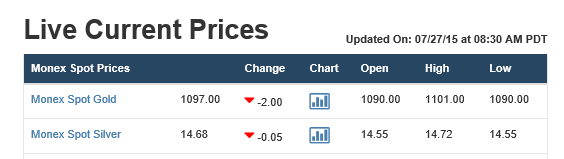
By the looks of these prices, the physical bread famine is also getting well under way. The price of wheat and corn are already there. The price of gold is totally arbitrary. In times of scarcity, it will be the bread and water itself that is most valuable, as you can’t eat and drink actual gold or silver. That is why hoarding Gold or silver is not going to be the panacea people think it will be.

Of course, back in the day and time that the Bible was written, it wasn’t wheat, it was corn that was such a staple crop.
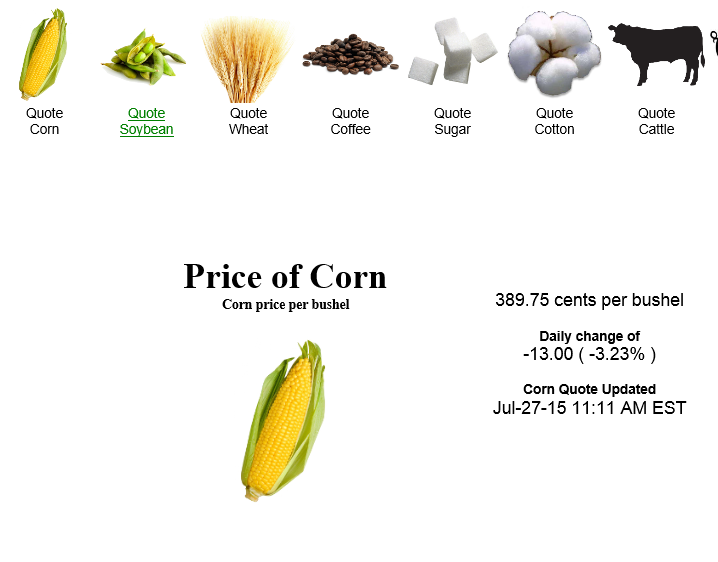
So here is todays corn price as well:

 Serve Him in the Waiting